
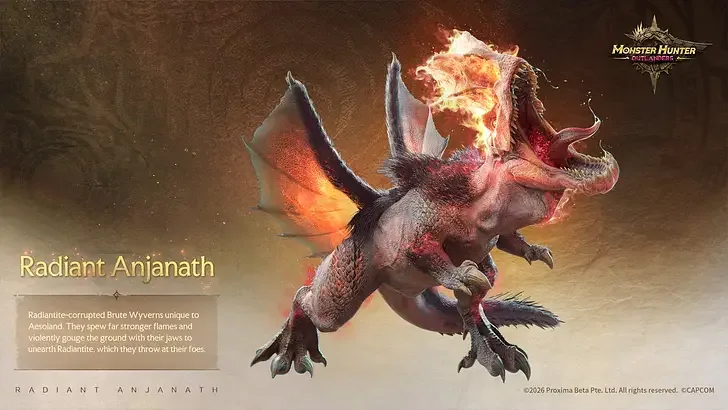
Radiant monsters are Aesoland-native variants empowered by the mineral Radiantite. They use new elemental attacks, leave hazardous terrain and drop Radiant materials for separate gear. Break the glowing Radiant part to knock them out of their powered state.
Field note
What are Radiant monsters?
Every large monster in Monster Hunter Outlanders is tied to Aesoland's ecosystem, and Radiantite is the mineral at the center of its mystery. Radiant species are monsters changed by exposure to that mineral. Their attacks carry a new visual language: glowing cracks, golden shards, molten light and lingering ground hazards.
A Radiant hunt is a remix. The monster keeps its base identity, but adds a new resource for you to manage. Some versions hit harder, others create new terrain problems or alter a familiar combo's timing. The important thing is to learn the remix instead of relying on muscle memory from the base fight.
Field note
Confirmed Radiant species
The closed beta roster and official site confirm 18 Radiant forms, all built from returning monsters except Kushala Daora and Nergigante. This list may expand at launch and in future updates; our monster database is updated as new forms are verified.
| Radiant form | Base hunt | What changes |
|---|---|---|
| Radiant Rathalos | Rathalos | Near-molten flame and heavier aerial pressure |
| Radiant Rathian | Rathian | Stronger venom and faster tail sequences |
| Radiant Pink Rathian | Pink Rathian | Upgraded poison tail patterns |
| Radiant Anjanath | Anjanath | Molten rock eruptions and stronger fire breath |
| Radiant Barroth | Barroth | Radiantite-crusted plating |
| Radiant Black Diablos | Black Diablos | More aggressive charges and burrow pressure |
| Radiant Diablos | Diablos | Horns that shatter rock and tougher burrow attacks |
| Radiant Great Girros | Great Girros | A stronger pack and heavier paralysis pressure |
| Radiant Great Jagras | Great Jagras | Radiantite spit and a heavier belly slam |
| Radiant Jyuratodus | Jyuratodus | Reinforced mud trails |
| Radiant Kulu-Ya-Ku | Kulu-Ya-Ku | Radiantite rock throws and stronger forelegs |
| Radiant Legiana | Legiana | Ice shards and faster aerial recoveries |
| Radiant Odogaron | Odogaron | A faster, more punishing chase sequence |
| Radiant Paolumu | Paolumu | Radiantite-charged wind and lingering hazards |
| Radiant Pukei-Pukei | Pukei-Pukei | Poison pools and Radiantite projectiles |
| Radiant Radobaan | Radobaan | Radiantite-reinforced bone plating |
| Radiant Tobi-Kadachi | Tobi-Kadachi | Stronger electric wall runs |
| Radiant Tzitzi-Ya-Ku | Tzitzi-Ya-Ku | A more dangerous flash and Radiantite pressure |
Field note
How Radiant parts and Radiant Rage work
Radiant monsters can enter a powered state known in beta material as Radiant Rage. The transformed part glows, hits harder and may create new hazards. The hunt plan is to break that bright part to knock the monster out of the state and create a long damage window.
A successful Radiant part break often creates a longer topple than the base monster's equivalent break. That is your best damage window. Do not spend it on a safe leg hit if the head or a glowing plate is exposed.
Field note
Which elements should you bring?
Radiant forms usually keep the base monster's core weaknesses, but the new attack pattern can make a defensive skill more valuable than a few percent of elemental damage. Bring the base weakness first, then adjust for the hazard: Fire Resistance for molten ground, Poison Resistance for venom, or Wind resistance for aerial control.
Do not blindly stack the base element if your damage is already low. A safe clear with a neutral raw weapon is better than a perfect elemental build that spends half the fight healing.
Field note
Radiant materials and gear
Radiant hunts drop unique materials used in their own weapon and armor upgrades. These are often separate from the base monster's tree, so a Radiant monster is not just a harder way to farm the same parts. Check the forge before you decide which version to hunt.
The Apex weapons seen in the third closed beta are a separate high-tier progression track tied to Elder Dragon materials. Do not confuse them with Radiant gear. The full material list and upgrade logic are covered on each monster page.
Field note
Radiant hunt checklist
Radiant hunts punish autopilot. Use this checklist before every attempt.
- Verify the base weakness and any new elemental hazard.
- Bring a weapon that can reach the Radiant part you need to break.
- Plan one defensive skill for the new ground hazard or projectile pattern.
- Do not use your biggest attack before the part break unless the monster is already toppled.
- Check the updated material list; Radiant drops may not replace base drops.
Quick answers